Unsafe, Insane, Consensual? Should Dark Romance Be Considered Erotic Horror Literature?
“The fantasy of a man like you is how we cope with the reality of a man like you” (You, S5.E10)
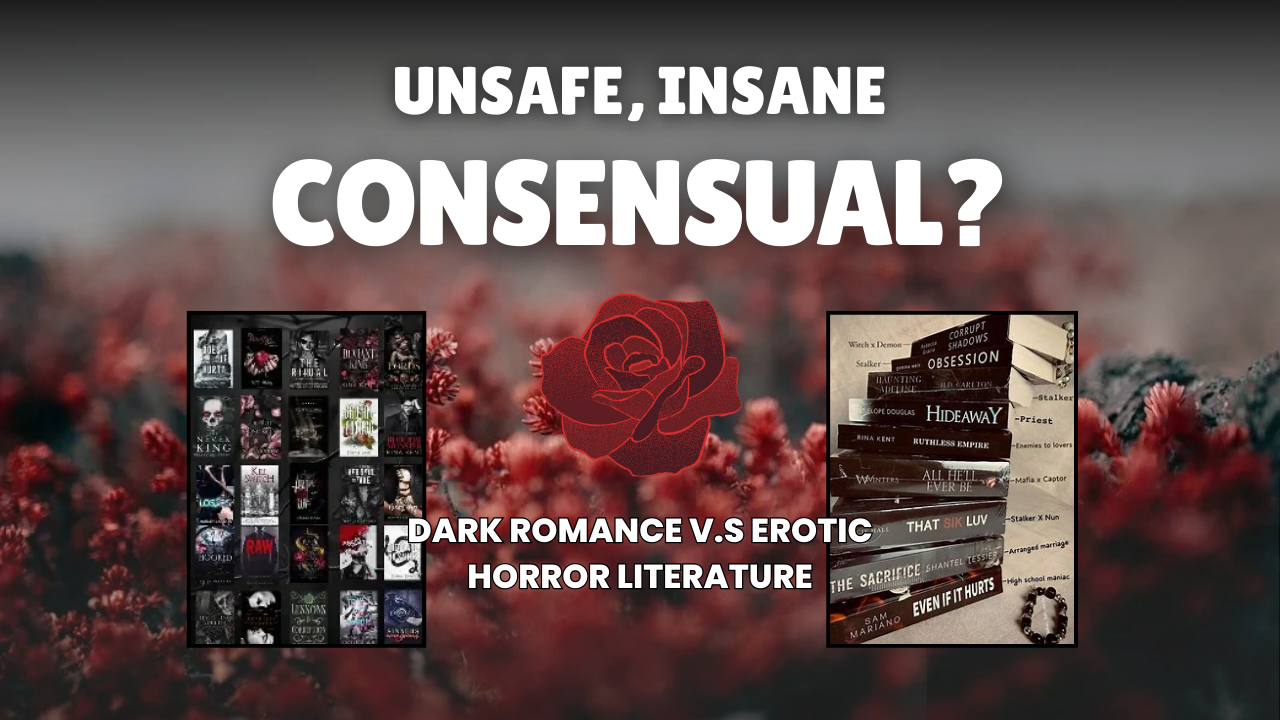
Disclaimer & Content Warning
In this article, I discuss the importance of consent, unconventional and unsafe romances, erotica, and fictional rape and sexual assault scenes in “dark romance” literature. Please read at your own discretion. While it is absolutely necessary for these kinds of discussions to take place, please take care of your wellbeing when doing so. There are resources at the end for survivors and those who continued on and would benefit from further supports.
Additionally, there is nothing morally wrong with reading, writing, or enjoying dark romance and/or erotic horror. Yes, there are complexities to the ethics of the media we consume, but that is tied with our response to it and the world around us, not the initial consumption itself. Dark Romance and Erotic Horror are both forms of literary escapism and reclamation of power for those who have experienced sexual assault and domestic abuse, and the following critique of the genres’ marketing and labeling has nothing to do with, nor should be used to dismiss or invalidate their experiences, creation, preferences, or affiliation with either genre.
Introduction
A rose appearing out of nowhere.
A twig snapping behind you.
A waitress witnessing something she really shouldn’t have.
When you hear of “Dark Romance”, you might think to such scenes of imbalanced power dynamics, bodice rippers, bloody obsession, and a thriller chase through the woods. Relevant case studies in media today like Lights Out by Navessa Allen, Haunting Adeline by H.D Carlton, and Credence by Penelope Douglas remain primaries in book recommendations for the genre. In all literature we consume, it’s adamantly clear how crucial language is, and furthermore, the names we call for them. Why bring this up now? Because our “Dark Romance” falls more accurately with Erotic Horror, and the lack of distinction between the two genres looms a large threat powered by misogyny and rape culture, known as the romanticization of assault.
Definitions
Before we dive in, let’s understand the differences between Romance and Dark Romance, and Horror and Erotic Horror.
Romance: A story that shows humanity’s reaction to being put in a normal or best possible situation, with specifics on how they react to intimacy, vulnerability, and love. Can be philosophically charged as social commentary, or motivated by entertainment/enjoyment escapism.
Dark Romance: A story that shows humanity’s reaction to being put in the worst possible situation, with specifics in to how they react to intimacy, vulnerability, and love. Can be philosophically charged as social commentary, a healing/reclamation on power, consent, and autonomy, or an entertainment/enjoyment escapism.
Romance is a normal or best case situation, with a safe and consensual conventional relationship. Dark romance is a worst case situation, with an unsafe but still consensual, unconventional relationship.
Horror: A story that shows humanity’s reaction to being put in the world possible situation. Can be philosophically charged as a social commentary, a healing/reclamation of power, or a motivated by slasher/gore shock factor thrill.
Erotic Horror: A story that shows humanity’s reaction to being put in the worst possible situation, in specifics to loss of autonomy, loss of consent, extreme possession, and extreme obsession. Can be philosophically charged as social commentary, a healing/reclamation of power from trauma, or slasher/gore shock factor thrill.
Horror is a worst case situation. Erotic horror is a worst case situation with an unsafe and unconsensual, extremely unconventional relationship.
Notice the similarities between Dark Romance and Horror, all the while the difference between Dark Romance and Erotic Horror? That’s because historical dark romance, emerging from gothic literature of the 18th century, is actually a subgenre of both romance and horror, rather than only the former.
Gothic Literature & The Historical Timeline Of The Dark Romance Genre
1700s-1900s: The Genesis of Gothic Literature & Romanticism
With the rise of gothic literature and the romanticism era, stories that dissect unconventional relationships, ethics, morality, mortality, and humanity’s role within nature and love come into popularity — dark themes and settings, the development of science fiction, otherness, and battles of love, revenge, independence, soul, and sin. The origins of the gothic genre commenced with literary works like The Castle of Otranto by Horace Walpole, Frankenstein by Mary Shelley, and Weathering Heights by Emily Brontë. Additional books that were critical to this time period, and the cultivation of the romanticism movement and storytelling that focused on human emotion include Jane Eyre by Charlotte Brontë, Dracula by Bram Stoker, The Count De Monte Cristo by Alexander Dumas, Pride & Prejudice by Jane Austen, The Scarlet Letter by Nathaniel Hawthorne, and many other fine classical works.
1970s-1990s: The Era Of Bodice Rippers & Modern Gothic Literature
Continuing the gothic legacy and redefining how monsters are perceived, we have the late 1900s. Unconventional relationships are one again brought to the forefront of literary media, and now the topic of a woman’s sexuality and escapism have emerged in the form of bodice rippers. Sin, mortality, and lust are key themes within the genre’s literature. Many of which are written by women in abusive relationships and marriages, that wish to feel romance within their lives, projecting into a fictional universe. The lines between explicit consent and a woman’s desires are further blurred. Critical media from this time included bodice rippers, Anne Rice’s Interview With A Vampire, and the Phantom of the Opera’s Broadway Debut.
2000s-Present: The Era of Vampires That Sparkle, Modern Dark Romance, & Popularized Erotic Horror
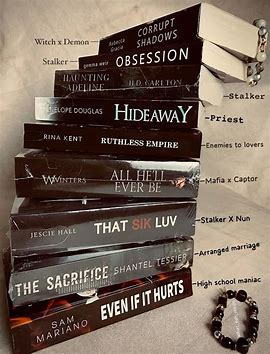
Sexuality, mortality, reverse harem, and the explicit become mainstream. From reimagining’s of monsters under a romantic lens, werewolves, vampires, and demons — the “conventionally evil” is depicted to symbolize sensuality, sin, morality, forbidden affection, and inclusive otherness. The unconventional is taken to a more direct and violent level, and bodice rippers are intensified into a modern light, utilizing further the gothic intersections of danger and romance. Now, however, with an explicit and modern take. Stalkers, captors, killers, mafia leaders, and fantastical creatures with animalistic biology or reproductive systems, dance the lines of power dynamics, dominance and obedience, predator and prey, trust and intimacy, consent and desire, and sexuality and purity. While still ever-changing, key stories within the movements’ vast spectrum of intensity include Twilight by Stephanie Meyer, Fifty Shades of Grey by E.L. James, Twisted Love by Ana Huang, and Haunting Adeline by H.D Carlton.
The Fantasy V.S The Reality
No matter the amount of erotic horror books published under the genre “dark romance”, and no matter how publicly agreed that term for that type of story is, the withdrawal of consent is not romance. By allowing it to exist under such terminology, we uplift the notion that rape culture already projects into our lives, which is that without communication and safewords in place, no doesn’t mean no.
Reading dark romance books and enjoying the content doesn’t mean that you will enact such violence in real life, just like playing violent video games doesn’t mean that you will seek to hurt people in real life either, but there is a reason we call these videos games for what they are, fictional violence. So let’s call the fictional disregard for consent for what it is too. It’s horror, not romance.
Fear can be sexy, with consent and communication. There, again, is a reason that proper BDSM and kink etiquette around consensual non-consent or fearplay exists. It’s not immoral or romanticizing assault, as long as it acknowledges safewords, check-ins, and that the scene is just a scene, and can stop at any time — as long as it is planned out before hand, and there is a mutual bond of trust fostered on intense communication and intimacy. Fictional stories marketed as “Dark Romance”, yet include scenes with a disregard of consent with the intended love interest, don’t have any of that. The characters aren’t discussing their boundaries or hard no’s. They aren’t establishing exits or safety measures. For us, it is fictional, but in the character’s world, it is real and not pre-discussed or communicated. That makes it a horror, not a romance. The reason fear in the real world can be hot is because we know we have the power and autonomy to stop if we so desire, but can still choose to continue. There is no choice or autonomy in “Dark Romance” fiction. It continues regardless of the protagonist’s say. That makes it horror, not romance.
Genre Classifications
Disclaimer
The following books are categorized on whether a sexual assault, rape, or unconsented sexual intimacy took place between the love interest and protagonist, regardless of if on page or not, and how the writing handles their relationship after the fact. If it occurs, and especially if it treated as romantic, it is Erotic Horror. If it does not occur, and the relationship is unconventional, unsafe, but still consensual at the end of the day, it is Dark Romance.
Additionally, if consent is given, but it is unclear, dubious, or the protagonist is written to be wanting to continue despite their lack of verbal consent, I analyze whether the love interest would have stopped if the MC had not only insisted, but even slightly stated or hinted at stopping. If they would not have, it is Erotic Horror. If they would have, while much more gray, it is Dark Romance.
If the relationship is twisted, dark, unsafe, insane, possessive, and batshit crazy, but still always consensual, it is a Dark Romance. The moment it is not consensual, it is Erotic Horror.
If planning to read, please review these books’ ratings and warnings first, regardless of the section I’ve listed it under, as they are all dark, regardless of if consensual. Additionally, many of books under the Dark Romance section do have explicit or described rape or assault scenes, though it is with the MC and other characters, not the love interest. Being listed under the Dark Romance section does not indicate a lack of rape entirely within the story, only a confirmed consent between the MC and the love interest. Reader discretion is heavily advised.
Popular DR Books That Are Indeed Dark Romance (DR)
Lights Out By Navessa Allen
The Risk by S.T. Abby
Twisted Love by Ana Huang
Insatiable by Leigh Rivers
Nocticadia by Keri Lake
Her Soul to Take by Harley Laroux
Phantasma by Kaylie Smith
Leather & Lark by Brynne Weaver
Popular “DR” Books That Are Actually Erotic Horror
Haunting Adeline by H.D Carlton
Credence by Penelope Douglas
God of Malice by Rina Kent
Cruel King by Rina Kent
The Sweetest Oblivion by Danielle Lori
The Ritual by Shantel Tessier
From Blood and Ash by Jennifer L. Armentrout
Den of Vipers by K.A. Knight
Keeping Her Under by Miranda Grant

Conclusion
Yes, the dark romance genre has a history of fictional relationships with no care for consent, fostered by authors who sought a fictional sense of their perceived romance outside of their abusive relationships and marriages (e.g., bodice rippers). That was their way of having conversations about violence and love. They couldn’t have public conversations about what consent was and its importance, whether they wanted to or not. They couldn’t speak on choice, autonomy, or communication.
We can.
We can have discussions revolving around the language we utilize within literature. We can converse on the intersections and boundaries of romance and horror. We can establish standards of consent and how we define our genres. We have the power and voice to speak on these matters. We have the voice they didn’t. Whether they would have agreed with us now, we have the choice to change how we discuss Dark Romance.
It’s always the question of choice that allows us to make these distinctions. Without choice, there is only unconsented and untrusted control. That’s a real life horror, so why shouldn’t it be considered one in fiction too?
Supports
I stumbled upon NO MORE when researching for sexual assault supports that could benefit readers from every country, not just my own in Canada. They provide outreach and resources for domestic abuse and rape survivors in over 200 countries across Europe, Oceania, The Americas, Asia, and Africa.
You deserve to feel safe again. You’re not alone.
You can contact the directory here.
“The NO MORE Global Directory is a first-of-its-kind, comprehensive international directory of domestic and sexual violence helplines, specialist support services, and resources for men, women, and those who identify as non-binary in almost every UN-recognized country and territory in the world.
The NO MORE Foundation created the site in partnership with the United Nations and the World Bank, and it serves as a global hub of information and resources for victims and their loved ones. This directory is the latest step in our efforts to create a world with NO MORE domestic and sexual violence.”
- The NO MORE Global Directory
References
Aria, N. (2023). The Evolution of Dark Romance: A historical perspective. Neda Aria. https://www.nedaaria.info/post/the-evolution-of-dark-romance-a-historical-perspective
Babaoğlu, C. (2025). The evolution of dark romance and how its meaning changed. https://typelish.com/b/the-evolution-of-dark-romance-and-how-its-meaning-changed-116729#google_vignette
Drrwpuser. (2025). A dark romance history lesson. Dark Romance Reads. https://darkromancereads.com/a-dark-romance-history-lesson/
Gothic Literature | Encyclopedia.com. (n.d.). https://www.encyclopedia.com/arts/educational-magazines/gothic-literature
NO MORE. (2024). NO MORE Global Directory • NOMORE Global Directory. NOMORE Global Directory. https://nomoredirectory.org/